About United States Currency
US Currency Issues | Collecting
Categories| Star Notes
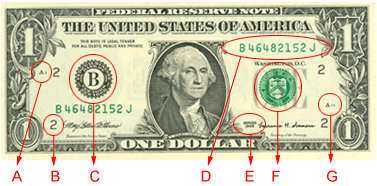
Currency Grading Standards | Anatomy
of a $1 Bill
US
Currency Issues:
A.
- Demand Notes 1861-1862
The
first paper money created by the US Government for general
circulation. These notes were payable "on demand"
at certain Treasury offices. Interestingly, the term "greenback"
originally comes from these notes as the reverse of the
notes was printed with green inks.
B. - United States Notes 1862-1994
United States Notes (characterized by a red seal and serial number) were the first national currency, authorized by the Legal Tender Act of 1862 and began circulating during the Civil War. Also known as legal tender notes, United States Notes were issued in denominations of $1, $2, $5, $10, $20, $50, $100, $500, and $1,000. United States Notes were widely used well into the 20th century. The interesting, and often intricate designs of large size legal Tender Notes have made them particularly popular with collectors and several have been given interesting nicknames such as: “Rainbow” ($10 Legal Tender – Series 1869), “Bison” ($10 Legal Tender – Series 1901), “Woodchopper” ($5 Legal Tender – Series 1907), and “Sawhorse Back” ($1 Legal Tender – Series 1917).
C. - Fractional Currency 1862-1876
As tensions escalated between the north and south, public confidence lessened and many individuals hoarded coins due to their inherent value. As a result, the number of coins in circulation dropped, almost to the point of disappearance. Merchants and customers had an increasingly difficult time making change for everyday transactions. In response, the US Government first authorized postage and other stamps to be used as "currency". Later paper notes in denominations of less than $1 were issued. Five issues of Fractional Currency were created, in denominations ranging from 3 cents to 50 cents. Additionally, numerous different designs were made for each denomination to combat counterfeiting attempts. The notes were also called "postage currency" because their designs resembled or mimicked those of its contemporary postage stamps.
Fractional currency was produced for 14 years. Once production of coinage was sufficient to cover demand, production stopped and people were able to redeem fractional notes for coins. Approximately $360 million of Fractional Currency once circulated. Of this, it is estimated that less than 1% still survives.
D. - National Bank Notes 1863-1938
Authorized by Federal Acts and issued by private banks prior to the issuance of currency by the US Government, National Bank Notes were treated much as international currency is today in the US. Exchange rates were often charged by a bank upon acceptance. Design of the notes, regardless of the issuing bank, was identical - name, location and charter number of the bank being the only differentiating features. All small size National Bank Notes are from Series 1929. They were issued through 1935, at which time the bonds securing the notes were called in.
E. - Gold Certificates 1878-1965
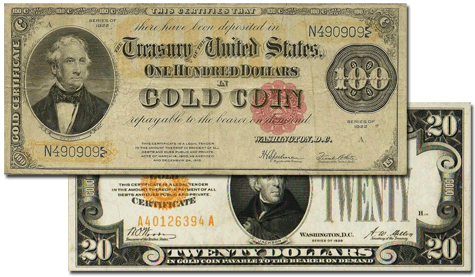
Click image to search for Gold Certificates on eBay
First produced in 1865, a total of nine issues of Gold Certificates would be created - four of which would circulate among the public. Largely, Gold Certificates were generally used by banks and other financial institutions. Gold Certificates were issued in denominations of $10, $20, $50, $100, $500, $1,000, $10,000 and $100,000, and were backed by an equivalent amount of actual gold deposited into the US Treasury. Some higher denominations circulated only among the Federal Reserve Banks. Large size Gold Certificates have brightly colored backs, and are considered to be among the most attractive of all US paper money. As with other notes, Gold Certificates were reduced in size in 1929, and the gold-colored back was dropped for the (now standard) green back designs. However, they retained a gold Treasury Seal and serial numbers.
F. - Silver Certificates 1878-1965
To increase the money supply, the US Government in 1878 decided to up production of silver coinage. The Government issued Silver Certificates in return for deposits of silver coins with the Treasury. As such, the notes were backed by an equivalent dollar amount of actual silver deposited into the US Treasury. If presented the Treasury would redeem these certificates for silver. If you have a question about the value of a Silver Certificate you may own, please see our Valuing FAQ. Modern, small size Silver Certificates are relatively abundant today, however many Silver Certificates remain popular among collectors. Examples include:
$1 "Funnyback" (Series 1928, 1928A, 1928B, 1928C, 1928D, 1928E, 1934) (click image to find on eBay)
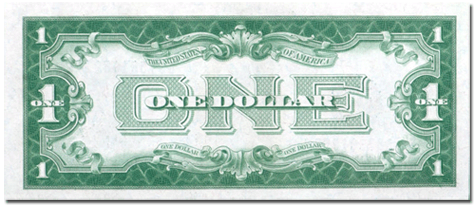
$1 "Martha Washington" (Series 1886, 1891) (find on eBay)

$5 "Educational" (Series 1896) (find on eBay)

$5 "Indian Chief" (Series 1899) (find on eBay)

$5 "Lincoln Porthole" (Series 1923) (find on eBay)

G. - Treasury (or Coin) Notes 1890-1899
Issued under an 1890 and 1891 Series, Treasury Notes in denominations of $1, $2, $5, $10, $20, $50 (1891 Series only), $100 and $1,000 were handed out to those individuals selling silver bullion to the Treasury. Once an individual was paid with these notes, he or she could then redeem them for gold coin. This redemption became a considerable burden on the Treasury.
H. - Federal Reserve Notes 1914-Present
Known best for being what is probably now in your pocket, Federal Reserve Notes are the only currency currently issued by the US Government. The notes were created as a result of the formation of the Federal Reserve System in 1913. As such, they are an obligation of the Federal Reserve system, no the individual banks names on the notes.
Early FRN issues were larger in size than the FRN's we are familiar with today. In addition, red and blue seals were displayed on these earlier notes. With the 1928 Series, the size of FRN's was reduced to their current measurements, and green Treasury seals were overprinted on all denominations. After 1945, the Treasury ceased printing of all notes over the denomination of $100, and in 1969, most notes $500 and over were taken out of circulation.
The design of FRN's remained the largely the same until the 1990's. New security features were added to the $5, $10, $20, $50 and $100 notes beginning with the 1996 Series, including larger portraits, watermarks, and color-shifting ink. With the 2004 Series, background color was added to the existing security features, further deterring counterfeiting. Modern, small size FRN's are widely collected today with early, and high denomination notes being amongst those that retain the highest collector value.
I. - Federal Reserve Bank Notes 1915-1945
Created at the time when National Bank Notes were being phased out, FRBN's were to take the place of these notes during the transition to Federal Reserve Notes. Federal Reserve Bank Notes were obligations of the individual Federal Reserve Banks that issued them, not the US Government, as is the case with Federal Reserve Notes.
US
Currency Collecting Categories
The following are simply suggested categories of US notes,
and are by no means the only way to categorize a collection.
1)
Large Size US Notes
2) US National Bank Notes (local bank issues)
3) US Fractional Currency
4) Colonial Currency
5a) Obsolete Notes (Issued by private banks in the 1880's)
5b) Confederate States of America notes
6) Small Size US Notes
8) Error Notes
Currency
Grading Standards
C.
Federal Reserve Bank Seal - The seal represents
the issuing Federal Reserve Bank, one of 12 in the US. See
B for specific FRB letter.
D.
Serial Number - Appearing twice identically
on the face of each note, the serial number is the unique
feature of each bill. The serial number includes prefix
and suffix letters.
E.
Series Date - The series date represents
the year the design of a particular note originated, not
necessarily the year it was released or printed. Series
date may also change when a major revision is made to a
bill. Minor changes to bill design are noted by adding a
letter to the series year, i.e. "1969C" or "1977A".
F.
Treasury Seal - This seal represents the
Department of the Treasury, established 1789. The current
seal (Federal Reserve Notes) is green, though different
colors have been used on past bills.
G.
Plate Serial Number - This number, different
than the Plate Position Number, represents the actual printing
plate used to print the note.
Have
a correction or addition to the information on this page?
We welcome and appreciate all feedback.